Andrej Karpathy, my dad and keeping up
Geschreven op 2 May 2026
For the insiders Andrej Karpathy needs no introduction, for the rest: Karpathy is among the very best in AI worldwide. He co-founded OpenAI and led AI and AutoPilot Vision at Tesla. He’s also a master at explaining things, and makes really fun and accessible videos on YouTube with titles like “Let’s build GPT: from scratch, in code, spelled out”. Lately he’s mostly focused on everything around LLMs, and he coined the term ‘Vibe coding’, which means ‘programming by just prompting’. You tell an LLM like ChatGPT or Claude what you want, and the LLM makes it for you. A great way for anyone, also non-programmers, to make software for the specific things you want to solve. Low barrier, online.
But now the reason I’m writing this. Yesterday the video below appeared, and I recommend taking half an hour for it. Or maybe two, because the information density is huge, and Andrej talks at double speed by default.
There are countless threads to pull on, like the fact that he said: I’ve never felt this much behind as a programmer. Yes really, Karpathy said that. But here I want to pick out one specific example that I ran into myself yesterday too.
Andrej says: Software 1.0 = you program the rules, classic software writing. Software 2.0 = you program the algorithm + model, and thanks to AI/Machine Learning the software learns by itself what it needs to do for the right outcome. Software 3.0 = the LLM does the work for you: You prompt, and the LLM makes code or even runs it directly.
MenuGen, from app to one LLM prompt
Andrej mentions the example of a menu. When you get a menu in a restaurant you usually don’t know some of the dishes. For this he made an app, with vibe coding: Upload a photo, and the app generates pictures and shows them to you. Handy! But have a look at his MenuGen post, and be amazed at all the integration headaches. Database, Stripe Payments, hooking up APIs. A whole production, code alone doesn’t get you there, something I wrote about earlier.
But recently those LLMs have become so capable that you can now give a prompt: “Gemini, look at this menu, and use NanoBanana to make pictures of all the dishes, and show them next to the dishes on the menu.”. And voila: You get your result. The whole app: no longer needed.
My own MenuGen moment
My dad is very into sustainability, has 10 solar panels, and asked me whether it would be worth it to get a home battery. Well, I wanted to dig into that. I made a web app, where based on his consumption and the solar radiation I measured with my own weather station I could make a real simulation of the savings you can get with a battery. For different batteries, payback time calculated, profit after 10 years, daily graphs if you wanted to check, beautiful work. One of the things I asked him for was a dump from his P1 smart meter, which luckily he had, so I could include his exact hourly consumption in my simulations.
I shared a few screenshots with him, and added: If you want to start simple you can take the Zendure SolarFlow 800 Plus, cheap start, quick payback. If you want to go a bit bigger you can take the Voltdeer SR5000; needs its own circuit, more expensive to buy but yields more in the end.
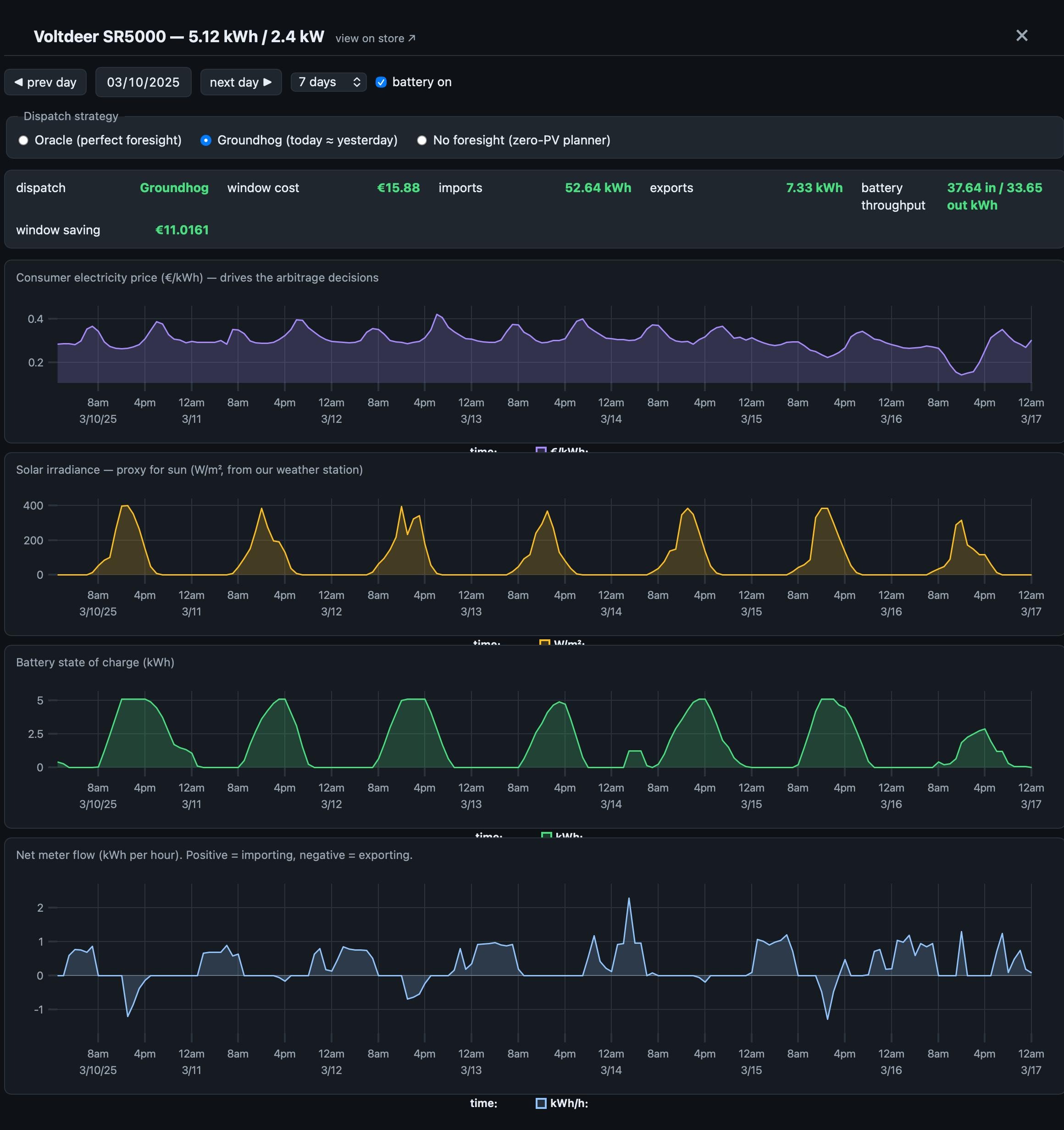
But what did my dad do: He gave the same P1 dump to Claude, and just asked Claude: Make an analysis of my electricity consumption and calculate what a home battery yields me; I have 3 kWp of solar panels, good luck. And from that Claude made a whole report, with conclusions. The final advice: Get a Zendure SolarFlow 800 Plus.
And then I can say: Yes but my numbers were more accurate (which I think is true). Yes but I show much more to give certainty (which I also think is true). Yes but.. but yeah… a few prompts vs a few hours of writing code, with exactly the same conclusion. While I was debugging, my dad was at his beach house on Texel.
I’ve been mulling it over for a few days, what does this mean exactly, and where does my unease sit.
When I look at my phone I see 3 categories of apps. The biggest group are apps with a unique service or content behind them. Services from banks, AH, navigation, online shops. And content from NRC, NYT, NOS, Netflix. Not really replaceable. The most-used group are social apps: Signal, WhatsApp, Bluesky, etc. Hard to replace, although in my own family I see that my own photo sharing app Acini gets used a lot, and there’s now more content posted than ever happened over WhatsApp. Sharing a photo is sometimes nicer than starting a chat. So a micro success. The third category: smaller apps with one purpose. Apps like Tessie, Justwatch, Vivino for example.
Apps in that last category are, in my view, the walking dead. They mostly process data that comes from somewhere else, and an LLM can do that very well. My data analysis for my dad is a good example of it. Because it’s a piece of cake (for me at least) to put together such an analysis yourself or instead (like he did) skip that whole phase with a few prompts. And that’s also a big enrichment: Everyone their own solution, exactly the way they want it. A thousand flowers.
But for small developers or shops it’s the kiss of death. And also for a lot of open source software: Why would I share my repo, or contribute to an existing project, if everyone can realize their own idea, thanks to LLMs that have been fed with those same software projects. So long, and thanks for all the fish. Code is no longer scarce. The economic shift is therefore that the value goes to the LLM providers. My dad has enough with his Claude Pro subscription, so twenty euros a month to Anthropic. And I do the same.
My dad closed our chat yesterday with “gotta keep up a bit, you know, with all the possibilities”. I think he meant himself. But it felt like he was talking to me.